


Age: 74
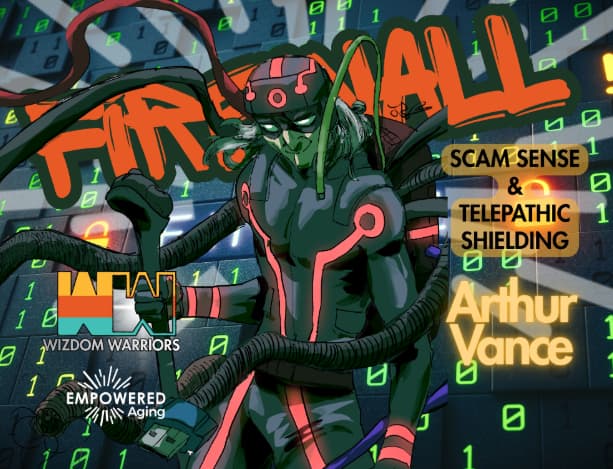
Superpower: Scam-Sense & Telepathic Shielding
Mission: Teaching readers to spot digital and telephone scams, freezing out financial exploitation, and keeping technology safe and secure.
Long before he became an Empowered, Arthur Vance was the man at the bank who didn’t like the look of a withdrawal.
He spent twenty-nine years in banking across the Bay Area, first as a teller, then as a branch manager, and finally as a fraud investigator. Arthur had a gift for noticing when a transaction didn’t fit the person making it. He saw the retired schoolteacher who suddenly wanted to wire $9,000 to a stranger overseas, and the widower buying gift cards by the stack with a phone pressed to his ear. Arthur learned that scammers rarely break into anything. They talk their way in, using urgency, fear, secrecy, and a convincing voice on the line. He also learned that the victims were never foolish. They were kind, trusting, and caught on a bad day.
After retirement, Arthur became the unofficial IT department for his entire church, his bowling league, and a good portion of his cul-de-sac. He taught neighbors to spot a fake email, set up their passwords, and hang up on a “grandchild in jail.” He never charged a dime.
Then, at 74, something shifted. Arthur became Empowered.
His instincts, already razor-sharp, took on a life of their own. Arthur now carries Scam-Sense, an uncanny ability to detect a fraudulent email, a spoofed phone call, or a predatory financial trick before it lands. A “final notice” text that feels off, a caller who insists on staying on the line, a too-good-to-be-true prize all set off an alarm only he can feel. And when a scam gets close to someone, Arthur raises his Telepathic Shield, a shimmering energy barrier around a senior’s savings, accounts, and personal information that stops a bad actor cold.
But Arthur will tell you straight: even the best firewall has a weak point, and it’s the moment someone feels rushed. Scammers know that. They manufacture panic, demand secrecy, and insist you act right now. His shield is strongest when the people inside it know the three simple moves that beat nearly every scam:
- Pause. Real emergencies can survive five minutes.
- Verify. Hang up and call the person or company back using a number you already trust.
- Tell someone. Scammers depend on silence. Talking it over with a family member, friend, or banker breaks their spell.
That’s why Arthur works alongside the real-life heroes who guard older adults’ finances every day: bank tellers and fraud analysts, Adult Protective Services, consumer protection agencies, law enforcement, family members, and neighbors who say, “That doesn’t sound right. Let’s check.”
Why Arthur? Why Now?
Financial exploitation is one of the most common and costly forms of elder abuse, and one of the least reported. Many victims feel too embarrassed to come forward, which is exactly what scammers count on. Fraud today arrives by phone call, text, email, social media, and fake websites, often impersonating a government agency, a bank, tech support, or a loved one in trouble.
If you or someone you know has been targeted, there is no shame in it, and there is help:
- National Elder Fraud Hotline: 1-833-FRAUD-11 (1-833-372-8311)
- AARP Fraud Watch Network Helpline: 1-877-908-3360
- Report to the FTC: ReportFraud.ftc.gov
- Contact your bank right away if money or account information has been shared.
- Contact Adult Protective Services if you suspect an older adult is being financially exploited.
- If someone is in immediate danger, call 911.
October is also Cybersecurity Awareness Month, so there’s no better time to meet Arthur and give your own defenses a tune-up.
In the issues ahead, watch for Arthur’s Scam-Sense in action, a field guide to today’s most common phone and online scams, and a closer look at how to freeze your credit, lock down your accounts, and keep your devices safe.